
Webster Parish Criminal Court Records
Criminal court records in Webster Parish are kept through the district-court record stream once a case is filed. The Webster Parish Clerk of Court criminal department holds 26th Judicial District Court criminal records for Webster Parish. Typical files can include bills of information, indictments, minutes, guilty pleas, orders, dispositions, sentencing entries, copies, certifications, and documents attached to expungement motions. The clerk's criminal background search is narrow: it covers 10 years and only the 26th JDC for Webster Parish.
The court structure affects every search. The 26th Judicial District Court has original jurisdiction over civil and criminal matters in Bossier and Webster Parishes, with six elected judges and an appointed hearing officer. Minden City Court handles Minden criminal, traffic, juvenile, and local civil matters, so Minden Police cases may not be found by treating every criminal question as a District Court search.
The District Attorney for Bossier and Webster Parishes is Schuyler Marvin. The DA screens and prosecutes felony and misdemeanor matters in the district-court stream, while the clerk keeps the court record after charges are filed. A charge shown in jail or arrest data should be reconciled with the prosecutor's filed charge and the court minutes before treating it as the final court result.
Search Webster Parish Criminal Records
The first search channel is the Webster ClerkNet App, followed by direct contact with the clerk's criminal department when the online route does not show the full case. ClerkNet exposes search labels for cases, name, party, date, civil records, Civil Docket, and account features. The research did not verify a complete public criminal case detail screen without account interaction, so a missing online image or limited result should not be treated as proof that no court file exists.
- Start with the defendant name, case number if known, approximate filing year, and whether the matter was District Court or Minden City Court.
- Use ClerkNet for public case-search labels and any available case or party route.
- Contact the clerk's criminal department when a full docket, minute entry, certified copy, or older file is needed.
- Use Minden City Court for city criminal matters and Minden Police tickets.
- Use Louisiana State Police Bureau of Criminal Identification and Information when the need is broader criminal history rather than a Webster Parish court file.
The clerk's criminal department states that fax filings are not accepted in criminal matters. Criminal copies cost $1 per page, certification of copies costs $5 each, and extracts of court minutes cost $10 each. Criminal background searches cost $20 and are limited to 10 years in the 26th JDC for Webster Parish.
Webster Parish Criminal Case Flow
A Webster Parish criminal court record grows as the case moves from accusation to court outcome. The arrest or booking event may appear first in sheriff or jail systems. The court case begins when the prosecutor files a formal charge, such as a bill of information or indictment. After that point, arraignment, pretrial motions, plea negotiations, trial settings, disposition, and sentencing create court entries that belong in the clerk-held file.
Case flow: Charges Filed › Arraignment › Pretrial / Motions › Plea or Trial › Disposition › Sentencing
| Stage | What Happens |
|---|---|
| Charges Filed | The DA files the formal accusation, often by bill of information or indictment, and the clerk opens or updates the criminal case. |
| Arraignment | The defendant appears in court, the charge is addressed, and a plea may be entered. |
| Pretrial / Motions | Attorneys file motions, the court sets hearings, and the docket may show rules, orders, or continuances. |
| Plea or Trial | The case resolves by plea, bench or jury trial, dismissal, or other court action. |
| Disposition | The record states the result of each charge, such as guilty, dismissed, not guilty, or other final action. |
| Sentencing | The court records punishment, conditions, fines, custody, probation, or other sentence terms if there is a conviction. |
Webster Parish Criminal Record Fields
A criminal court record should be read field by field. A single arrest can produce several charges, and each charge can have a different result. Docket entries and minute extracts may show what happened on a certain date, while certified copies of charging documents or guilty pleas may be needed for legal use. The research supports common record components, but it did not verify that every field appears in the public ClerkNet view.
| Field | What It Shows |
|---|---|
| Case Number | The clerk or court identifier used for the criminal case. |
| Defendant | The person charged in the criminal court file. |
| Charge | The offense filed by the prosecutor, which may differ from the initial booking label. |
| Charging Document | Bill of information, indictment, or other filed document that starts or defines the court charge. |
| Plea | The defendant's formal response, such as guilty, not guilty, or another plea allowed by court procedure. |
| Minute Entry | A court record of what occurred at a hearing or setting. |
| Disposition | The result of the charge, including conviction, dismissal, acquittal, or other resolution. |
| Sentence | Punishment or conditions ordered after conviction, if sentencing occurred. |
For the charge-focused path before final outcome, use the Webster Parish arrest records and court charges page. For all record categories, use the broader Webster Parish court records route.
Webster Parish Charges vs Convictions
A filed charge is an accusation. A conviction is a court result. The distinction matters in Webster Parish because jail roster charges, DA filings, docket entries, and final dispositions can show different stages of the same event. A charge may be amended, reduced, dismissed, dropped, or resolved by plea or trial. Read each charge line and each disposition line before drawing a conclusion from a criminal court record.
| Point | Charge | Conviction |
|---|---|---|
| Stage | Accusation filed or listed before final judgment. | Final result after plea, verdict, or court finding. |
| Source | Booking data, bill of information, indictment, or DA filing. | Court minutes, disposition entry, judgment, or sentence record. |
| Meaning | The person is accused of an offense. | The court has found guilt or accepted a guilty plea. |
| Record Caution | Can be changed or dismissed. | May still be subject to appeal, expungement limits, or later correction. |
Read Webster Parish Dispositions
Disposition means the result of a charge or issue. In criminal court records, it can show that a charge ended in a guilty plea, not guilty finding, dismissal, acquittal, or another court action. Sentencing is separate from disposition. A record may show a conviction first and then list jail time, probation, fine, conditions, or other sentence terms. If the online view is incomplete, request minute extracts or certified copies from the clerk.
The clerk's fee page matters here because it identifies the local copy path. Criminal copies cost $1 per page. Certifications cost $5 each. Extracts of court minutes cost $10 each. If an expungement motion needs minutes, guilty pleas, certified bills of information, or fingerprints attached, additional clerk charges may apply.
Note: A docket date can show activity, but a minute entry or certified document shows the court action.
Webster Parish Sealed Records
Sealed and expunged criminal records require careful wording. Louisiana expungement does not destroy the record. Code of Criminal Procedure article 973 explains the effect of expungement, and the research file states that expunged records remain subject to legally limited access. Juvenile records are restricted under a separate rule, and active investigatory material may also be limited.
| Point | Sealed | Expunged |
|---|---|---|
| Public View | Hidden or restricted by court order or law. | Public access is limited by expungement law. |
| Record Status | The file still exists with restricted access. | The file is not destroyed under Louisiana law. |
| Common Route | Court order, confidentiality law, or protected case category. | Motion or qualifying automated request process where allowed. |
| Local Caution | Juvenile, adoption, mental health, and protected personal data may be restricted. | The Webster Clerk requires separate expungement motions for each arrest date. |
The article 973 source is the first expungement image assigned to Webster Parish criminal court records.
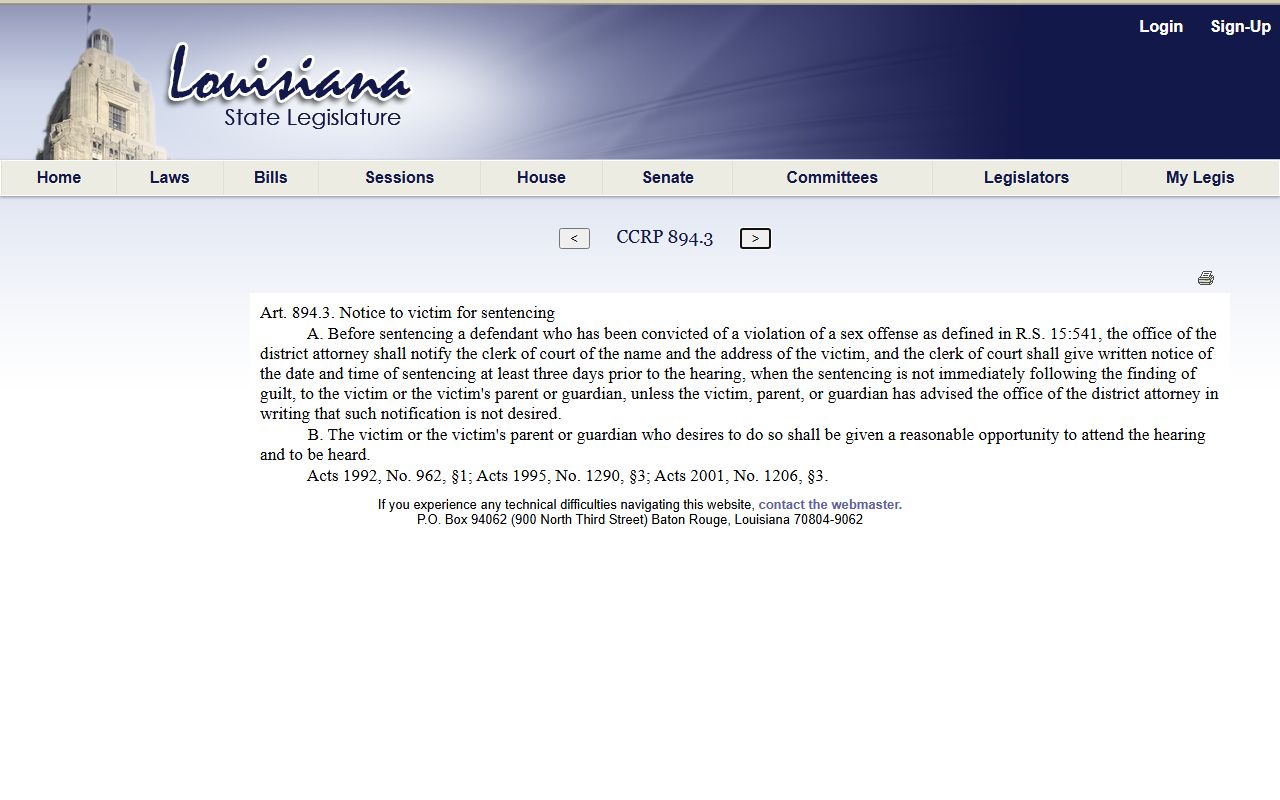
Use it to avoid the common mistake of saying an expunged Webster Parish criminal court record has been destroyed.
Webster Parish Criminal Expungement
The Webster Parish Clerk states that a separate Motion for Expungement must be filed for each arrest date. The clerk does not provide legal advice or expungement forms and recommends contacting an attorney. Each motion must include required payments or a fee-waiver certification from the District Attorney's Office. Required non-refundable payments listed in the research are $250 to Louisiana State Police, $50 to the 26th JDC District Attorney, $50 to the Webster Parish Sheriff, and a clerk payment of $150 for first-offense possession of marijuana or $200 for other offenses. For DWI convictions, the Office of Motor Vehicles adds a $50 money order.
Article 976 covers expunging arrests that did not result in conviction. Article 977 covers misdemeanor conviction expungement. Article 978 covers felony conviction expungement. Article 983 covers expungement costs and processing fees. Article 985.2 provides an automated expungement request process through the Louisiana Bureau of Criminal Identification and Information beginning January 1, 2025.
The article 976 source covers arrest expungement when no conviction resulted.
This source matters when a Webster Parish criminal court record shows an arrest path but no conviction outcome.
The article 977 source covers misdemeanor conviction expungement eligibility and limits.
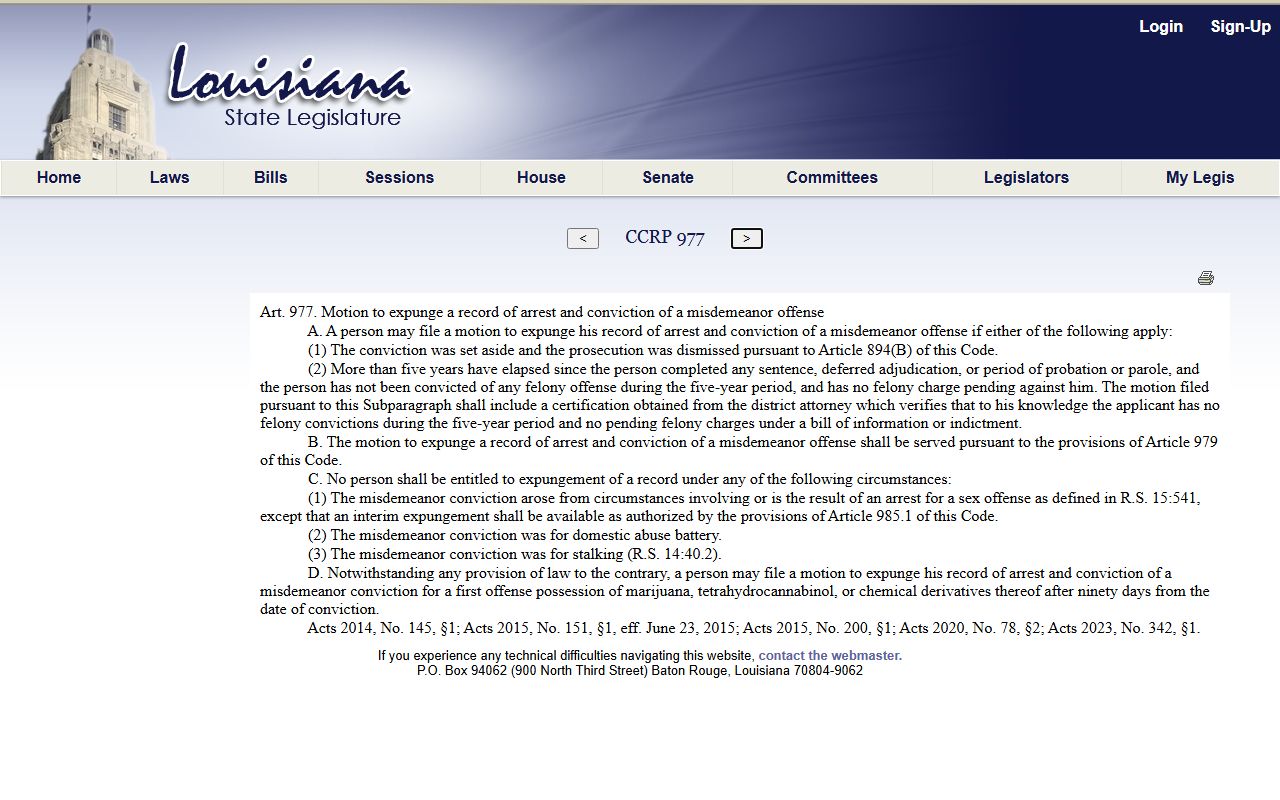
Use the misdemeanor rule only after reading the disposition and sentence for each charge.
The article 978 source covers felony conviction expungement eligibility and limits.
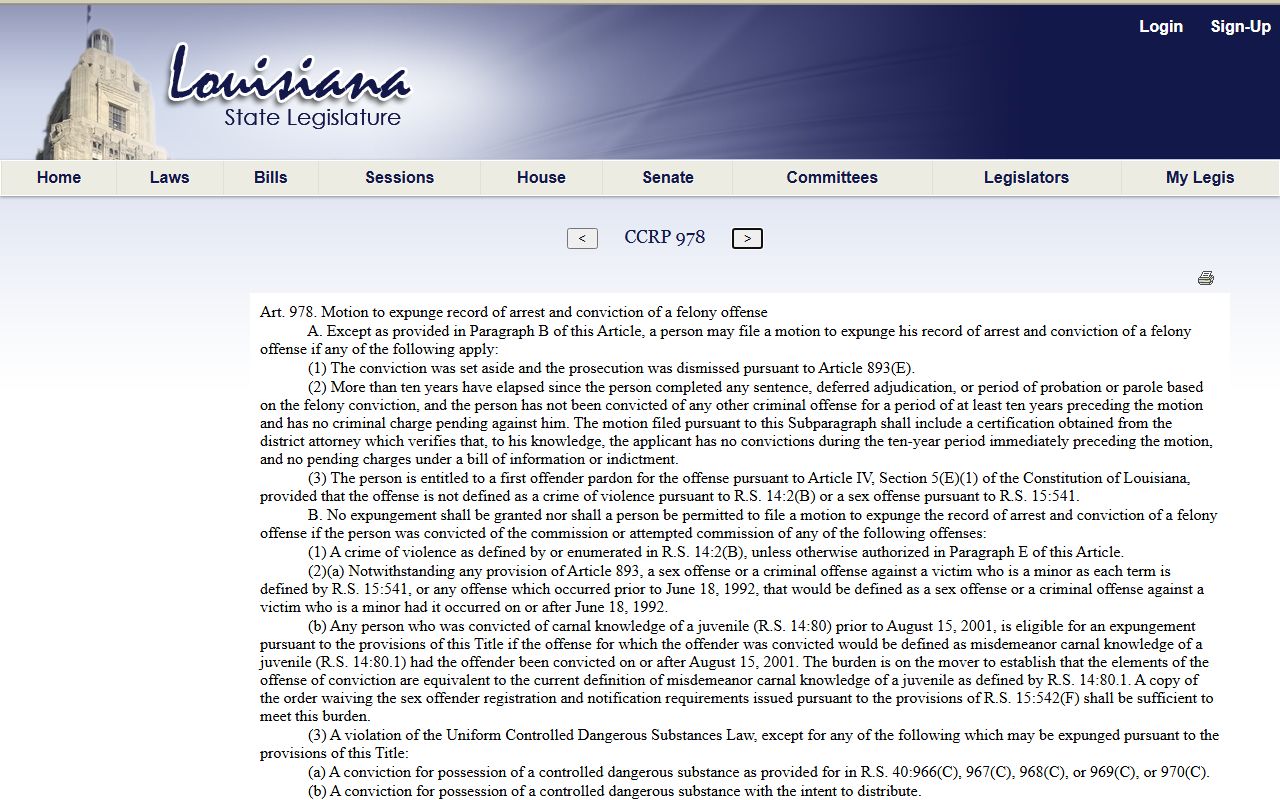
Felony records require close review because the filed charge, final conviction, and later eligibility may differ.
The article 983 source matches the fee and agency-payment structure described by the Webster Clerk.
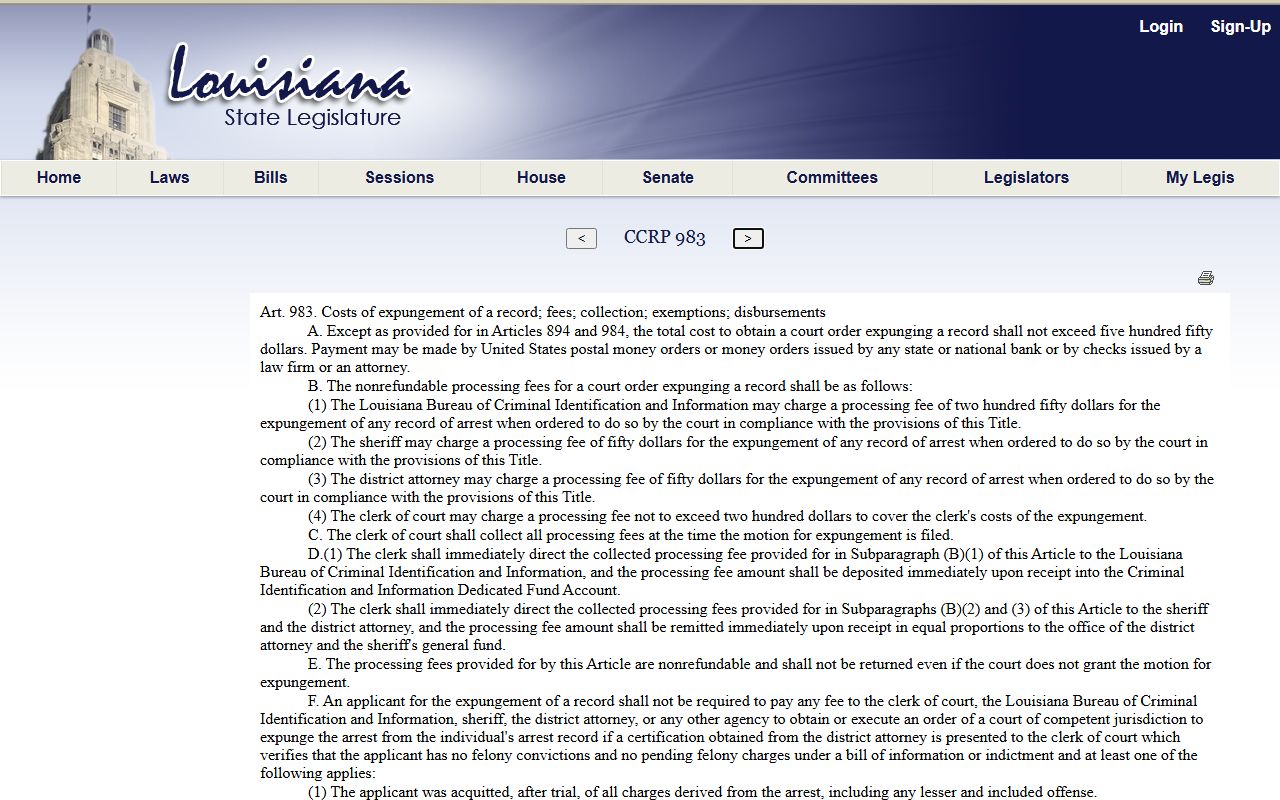
Confirm current payment instructions before filing because multiple agencies receive separate payments.
The article 985.2 source covers automated expungement requests beginning January 1, 2025.
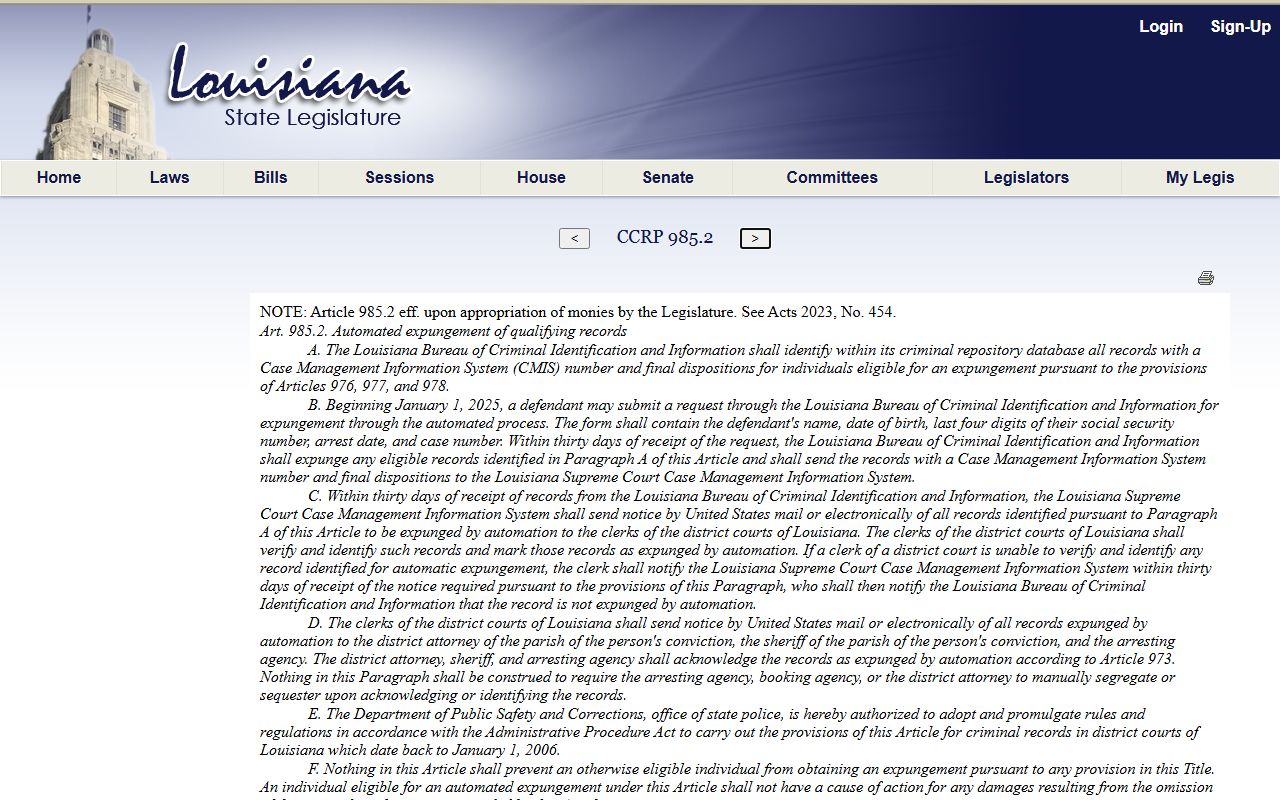
The automated request process does not remove the need to verify the Webster Parish court file and each arrest date.
Webster Parish Criminal Access
Public access to criminal court records comes from the general Louisiana public-records framework and court-record custodian rules, but criminal cases have important limits. La. R.S. 44:3 restricts certain law-enforcement and criminal-investigatory records. Louisiana Children's Code article 412 restricts juvenile court records. Sealed and expunged records, protected personal identifiers, victim safety information, and some mental health or incapacity material may also be withheld or redacted.
For practical access, use the clerk's criminal department for Webster Parish 26th JDC criminal case files, certified copies, minute extracts, and local background searches. Use Louisiana State Police for broader criminal-history requests. Use the sheriff or jail roster for current custody and booking data. These systems answer different questions, and none of them should be treated as a complete substitute for the others.
Restricted Webster Parish Criminal Records
Restricted Webster Parish criminal court records include juvenile cases, sealed files, expunged records, active investigatory material, and records with protected personal data. Adoption, mental health, interdiction, and judicial commitment records can also contain confidential information even when connected to a court file. A searcher may need party status, attorney access, agency authority, or a court order to see restricted material.
The safest rule is to separate public dockets from restricted documents. A public calendar setting may exist even when a document is not public. A case number may be known even when images are unavailable. A sealed or expunged result may not appear in a public search at all. Direct clerk contact is the right next step when a public online search conflicts with a known court notice, arrest date, or agency record.